What Is E-Commerce Data Scraping and Why Does It Matter for Pricing Strategy?
Pricing used to be a quarterly conversation. Now it's a continuous one — and the teams winning it are the ones with a real-time feed of what's happening across the market. Here's how that feed actually works.
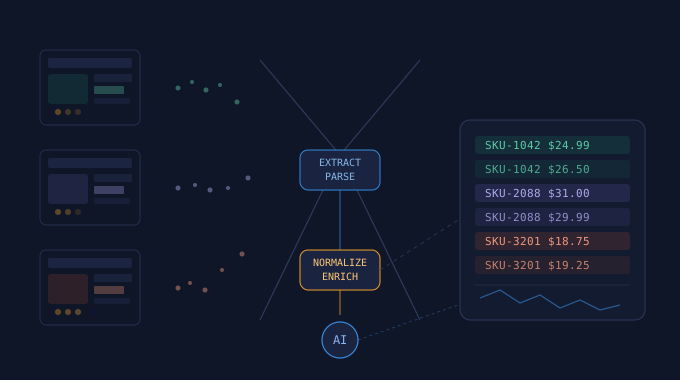
If you've ever manually checked a competitor's website to see what they're charging for a product you also sell, you've done a crude version of e-commerce data scraping. You visited a page, read a price, and stored that information somewhere — your memory, a spreadsheet, a Slack message to your pricing manager.
E-commerce data scraping is that same basic idea, industrialized. It's the automated extraction of structured data — prices, product names, availability, descriptions, reviews, promotional offers, shipping terms — from online retail websites at a scale and speed that no human team could match.
But calling it "just" data collection undersells what's actually happening in the market right now. The interesting shift isn't that companies are scraping competitor data. They've been doing that for years. The shift is what they're doing with it afterward — and how that's rewriting the rules of pricing strategy for everyone else.
How E-Commerce Data Scraping Actually Works
At its core, scraping is software that does what a browser does: it requests a web page, receives the HTML (or JavaScript-rendered content), and then extracts specific pieces of information from it. Instead of a person scanning the page visually, a parser identifies the relevant elements — the price tag, the product title, the stock status indicator — and pulls them into a structured format.
In practice, modern e-commerce scraping is considerably more complex than that simple description suggests. Online retailers use dynamic page loading, anti-bot protections, varying site structures, and frequent layout changes. A scraping system that worked last month might break this month because a retailer redesigned their product pages. Keeping extraction reliable across hundreds of sites that are all independently evolving requires ongoing engineering effort — which is one reason why most e-commerce teams eventually move toward specialized platforms rather than trying to build and maintain scrapers in-house.
The output, when it works well, is a continuous stream of structured, normalized data: every product, every price, every change, across every competitor you care about, updated at whatever frequency the situation demands.
What Gets Scraped (and Why Each Data Point Matters)
Pricing is the most obvious target, but it's far from the only one. A comprehensive view of the competitive landscape pulls in several layers of data, each of which tells a different part of the story.
Pricing data is the foundation. This includes regular prices, promotional prices, bundle pricing, tiered pricing, and dynamic prices that shift based on demand or time of day. Knowing a competitor's price at a single point in time is moderately useful. Knowing how their price has moved over the past 90 days — and how those movements correlate with yours — is significantly more valuable.
Product availability and stock signals often matter as much as price. A competitor showing "only 3 left" or "out of stock" on a product you carry in depth is a pricing opportunity most teams miss entirely when they're only watching prices. Scarcity signals from competitors can justify holding or even raising your price, rather than reflexively matching a lower one.
Product catalog and assortment data reveals strategic intent. When a competitor adds 40 new SKUs in a category, that's a signal about where they see growth. When they quietly discontinue a product line, that's a different signal. Tracking catalog changes over time gives you a map of competitor strategy that no earnings call or press release will provide.
Promotional patterns — what goes on sale, when, how deep the discount, and for how long — are some of the highest-value signals in competitive intelligence. A competitor who runs 20%-off promotions on the same category every six weeks is telling you something predictable and actionable about their inventory cycle.
Customer reviews and ratings, when tracked at scale, reveal product quality shifts, emerging complaints, and category-level sentiment trends. A competitor's flagship product suddenly accumulating negative reviews around a specific defect is information your merchandising team needs — not next quarter, but now.
From Raw Data to Pricing Intelligence
Here's where things get interesting, and where the gap between basic scraping and genuine competitive intelligence becomes significant.
Collecting data is a solved problem. The unsolved problem — the one that separates teams with a real pricing advantage from teams drowning in spreadsheets — is turning that data into actionable understanding.
Consider a scenario. Your scraper detects that a key competitor has dropped the price on 15 products in your shared catalog over the past 48 hours. The raw data tells you what happened. It doesn't tell you any of the things you actually need to know to respond. Are they clearing inventory? Responding to a third competitor you haven't noticed? Testing price elasticity? Launching a broader category offensive? Running a short-term promotion that'll revert by next week?
This is the interpretation layer — the part that transforms data into decisions. Increasingly, teams are applying machine learning and large language models to this problem, using them to detect patterns across large datasets, classify competitor moves by likely intent, flag anomalies that deserve human attention, and filter out the noise that doesn't. The goal isn't to remove human judgment from pricing decisions. It's to ensure that when a human does make a call, they're working with context and pattern recognition that would be impossible to assemble manually.
Why This Matters More for Pricing Strategy Than It Used To
The honest answer is that five years ago, e-commerce data scraping was a nice-to-have for most mid-market retailers. The pricing environment was slower, the number of competitors was smaller, and the margin of error was wider. A weekly manual check was often good enough.
Three things have changed that equation.
Price transparency has become total. Comparison shopping tools, Google Shopping, marketplace aggregators, and browser extensions mean your customers can see your competitors' prices with almost zero effort. The information asymmetry that once gave retailers pricing cover has collapsed. If you're priced wrong relative to the market, your customers know it — often before you do.
Competitor behavior has become more dynamic. More retailers are using algorithmic or rules-based pricing systems that adjust prices frequently. Some large players change prices on popular items multiple times per day. Competing against that cadence with weekly spreadsheet reviews is like bringing a notebook to a speed chess match.
Margins have compressed in most categories. When margins were comfortable, a suboptimal pricing decision cost you some profit but didn't threaten the business. In today's environment, the difference between a well-calibrated price and a poorly-calibrated one can be the difference between a viable product and one that's underwater. There's less room for error, which means the cost of operating with incomplete market visibility has gone up.
The Strategic Shift: From Reactive to Predictive
The most significant change that data scraping enables isn't faster reaction times, although that matters. It's the shift from reactive pricing to predictive pricing.
When you have months or years of structured competitor data — prices, promotions, stock levels, catalog changes — you can start identifying patterns that would be invisible at the surface level. Seasonal pricing cycles. Pre-launch discounting behaviors. The relationship between a competitor's stock levels and their likelihood of running a promotion. The price points at which demand in a category shifts visibly.
This is where pricing strategy stops being a spreadsheet exercise and starts being a genuine analytical discipline. Instead of asking "what should we do about this competitor's price drop," teams start asking better questions: "Based on historical patterns, how long is this price drop likely to last?" "Which of our products are most exposed to competitive pressure in the next 30 days?" "Where do we have pricing headroom we're not using?"
Those questions can only be answered with data that's comprehensive, continuous, and structured in a way that makes longitudinal analysis possible. Which brings us back to why scraping infrastructure matters — not as a technical curiosity, but as the foundation of a pricing strategy that's actually informed by what's happening in the market.
Common Misconceptions Worth Clearing Up
"We already do this with price tracking tools." Some teams use lightweight price monitoring tools that track a handful of competitor prices and send alerts. These have their place, but they're not the same thing as comprehensive data scraping. The difference is coverage and depth. A price alert tells you one thing changed. A full data pipeline tells you what changed, what else changed at the same time, how it compares to historical patterns, and what it might mean.
"Scraping is legally risky." The legal landscape around web scraping is nuanced and varies by jurisdiction, but scraping publicly available data — information that any consumer could see by visiting a website — is broadly practiced across the retail industry. It's the basis of every price comparison site your customers use. The key considerations are technical (respecting robots.txt, not overloading servers) and ethical (using data for competitive intelligence, not for counterfeiting or misrepresentation), not existential.
"We don't have enough competitors for this to matter." Even in a concentrated market with three or four key competitors, the volume of data points across a full product catalog is substantial. And in practice, most e-commerce businesses compete with more players than they think — including marketplace sellers, niche specialists, and cross-border retailers they may not be actively monitoring.
"Our pricing is value-based, not competition-based." Value-based pricing and competitive intelligence aren't opposing strategies. Even if you price primarily on perceived value, understanding the competitive landscape tells you where your value proposition is strongest, where it's under pressure, and where the market is leaving room for premium positioning. Competitive data doesn't dictate your price. It informs it.
Where This Is Heading
The trajectory is clear. E-commerce data scraping is moving from a back-office function to a core input in pricing, merchandising, and category strategy. The teams that treat it as a utility — always on, deeply integrated into their decision-making workflows, enriched with analytical intelligence — are building a compounding advantage over those who treat competitive data as a periodic check-in.
The interesting question for most e-commerce teams isn't whether they need this kind of market visibility. It's whether they're getting enough of it, fast enough, and in a form they can actually act on. For a growing number of teams, the honest answer to that question is prompting a serious rethinking of how they approach competitive intelligence from the ground up.