5 Signals That Your Competitor Is About to Change Their Pricing
Price changes don't come out of nowhere. They leave a trail of breadcrumbs — if you know where to look. Here are the signals that experienced e-commerce teams watch for before a competitor makes their move.
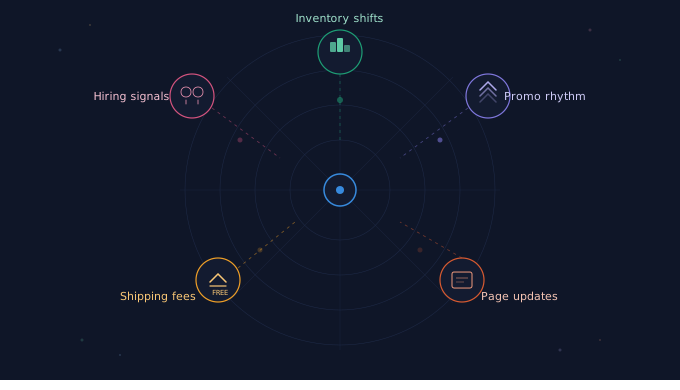
By the time a competitor's new price shows up on their product page, the decision behind it was made days or weeks ago. And in most cases, the conditions that led to that decision were visible well before the price tag changed.
The difference between teams that get blindsided by competitor pricing moves and teams that anticipate them isn't luck or insider knowledge. It's pattern recognition. Once you've tracked enough competitors across enough product cycles, you start to see that price changes are rarely isolated events. They're the final step in a sequence — and the earlier steps leave traces.
Here are five signals that reliably precede pricing changes in e-commerce, and what each one tells you about what's likely coming next.
1. Inventory Levels Are Moving in an Unusual Direction
This is the single most reliable leading indicator of a price change, and it's the one most teams aren't watching closely enough.
When a competitor's stock levels on a particular product start climbing — "in stock" turns into "plenty available," delivery estimates shorten, or previously limited quantities appear to open up — there's a good chance that product is about to get cheaper. Excess inventory creates internal pressure. Warehousing costs mount. Cash is tied up. At some point, someone in the organization is going to push for a price reduction to move units, and the rising inventory is the signal that conversation has either started or is about to.
The reverse is equally telling. When stock indicators start tightening — availability shifts from "in stock" to "only a few left," delivery windows stretch, or certain variants disappear — a price increase or a reduction in discounting is often imminent. Scarcity gives a competitor permission to hold or raise their price, and most will take it.
The key is tracking these signals over time rather than looking at a single snapshot. An "only 3 left" badge means nothing in isolation. An "only 3 left" badge on a product that showed full availability two weeks ago, combined with no restock pattern, tells you something specific and actionable.
What to do when you see it: If a competitor appears to be accumulating inventory in a category where you compete, prepare for potential price drops but don't preemptively match a move they haven't made yet. Instead, review your own position: are your margins healthy enough to absorb a temporary price war, or should you differentiate on other factors — faster delivery, better bundling, superior product content — before the pressure arrives? If stock is tightening on their side, it's your window to capture demand they can't fulfill, potentially at a stronger margin than usual.
2. Their Promotional Rhythm Has Broken
Every retailer has patterns, even if they don't realize it. Regular sales cycles, predictable discount depths, recurring category promotions that line up with supplier agreements or seasonal inventory flows. When you've watched a competitor long enough, you develop a baseline sense of their promotional tempo.
A break in that rhythm is a signal worth paying close attention to.
If a competitor who runs 15%-off sales on a category every four to six weeks suddenly goes quiet for two months, something has shifted internally. Maybe they're preparing for a larger repositioning. Maybe they've renegotiated supplier terms and don't need the promotional crutch anymore. Maybe they're about to launch a new pricing structure entirely.
The opposite is also telling. If a competitor who rarely discounts suddenly starts running aggressive promotions on a specific product line, that's often a leading indicator of a broader strategic change — a category exit, a pivot to a different product mix, or a response to competitive pressure from a direction you might not be watching.
Promotional anomalies are especially valuable signals because they reflect internal decisions. A price change might be algorithmic. A deviation from an established promotional pattern is almost always the result of a human decision somewhere in the organization — which means it's more likely to signal something strategic rather than tactical.
What to do when you see it: Map out your key competitors' promotional history over the past six to twelve months. Look for cadence, discount depth, and which categories get promoted together. Once you have that baseline, deviations become obvious — and you can start preparing your response before the actual pricing move materializes. When a competitor goes quiet on promotions, it's a good time to review whether your own discounting is creating unnecessary margin leakage in a category where pressure is actually easing.
3. Their Product Pages Are Getting Updated
This is a subtle one, but it's surprisingly predictive. When a competitor starts making noticeable changes to product page content — rewriting descriptions, adding new feature callouts, updating images, introducing comparison tables, or reworking how they present value — a pricing change is often close behind.
The logic is straightforward. If you're about to raise a price, you want the product page to support the higher price point. That means reinforcing perceived value: better imagery, more detailed specs, stronger positioning language. If you're about to drop a price, you might simplify the page, add urgency messaging, or introduce a "compare and save" framing that makes the new lower price feel like a deliberate offer rather than a retreat.
New bundling or cross-sell modules appearing on a product page are a particularly strong signal. When a competitor starts pairing a standalone product with accessories or complementary items, they're often preparing to shift the pricing model — raising the base price while offering the bundle at a "deal," or using the bundle to obscure a per-unit price change.
Product page updates also sometimes precede a relaunch or a new version release, which typically means the current version is about to be discounted to clear remaining stock.
What to do when you see it: Track product page changes alongside pricing data, not separately. When you notice a burst of content updates on products where you compete directly, treat it as an early warning. Review your own product pages in that category. If a competitor is about to reposition a product at a higher price point with better content, that's an opportunity to evaluate whether your own content and pricing support the value you're delivering — or whether you've been leaving repositioning opportunities on the table.
4. They're Adjusting Shipping Thresholds or Ancillary Fees
Pricing strategy in e-commerce isn't just the number on the product tag. It's the total cost equation — and savvy competitors often adjust the peripherals before they touch the headline price.
Watch for changes in free shipping thresholds. When a competitor lowers their free-shipping minimum, they're effectively reducing the total cost for a segment of their customers without touching the product price. This can be a precursor to a broader price competition strategy — they're testing demand sensitivity with the shipping lever before committing to a product-level price change.
When a competitor raises their free shipping threshold or introduces new fees — handling charges, extended delivery surcharges, return fees — they're often creating margin room to lower headline prices. The total cost to the customer stays similar, but the visible price drops, which plays better in comparison shopping results and aggregator listings.
Changes to return policies, warranty pricing, installation fees, or subscription and loyalty program structures all fall into the same category. They're adjustments to the total value equation that often foreshadow or accompany a recalibration of the sticker price.
What to do when you see it: Stop evaluating competitor pricing in isolation from their total cost structure. Build a view that captures shipping thresholds, ancillary fees, loyalty program benefits, and return policies alongside product prices. When any of these peripheral elements change, ask what it does to the competitor's effective price at various basket sizes — and what it might be setting up. A competitor who just lowered their free shipping minimum has created headroom to raise product prices without increasing the customer's real cost. If you're only watching the product price, you'll misread the move when it comes.
5. They've Hired (or Are Hiring) for Pricing and Analytics Roles
This is the longest-lead signal on this list, but it might be the most strategically significant.
When a competitor starts hiring pricing analysts, data scientists focused on commercial optimization, or heads of pricing strategy, something is shifting in their approach to how they set prices. These aren't maintenance hires. They're investment hires — the kind that get approved when leadership has decided that pricing is going to be a more active, data-driven function than it's been in the past.
Job postings are public information, and they're remarkably revealing. A listing for a "dynamic pricing manager" tells you a competitor is moving toward algorithmic pricing. A "competitive intelligence analyst" listing tells you they're investing in market visibility. A "commercial data engineer" posting suggests they're building the infrastructure to ingest and act on market data at scale.
The lag between the hire and the impact on pricing can be three to six months, sometimes longer. But the signal is clear: this competitor is going to become more sophisticated, more responsive, and harder to compete against on pricing. The best time to prepare for that is before the new hire starts publishing their first pricing recommendations.
What to do when you see it: Monitor key competitors' careers pages and LinkedIn postings as part of your competitive intelligence routine. When you see a cluster of hires around pricing, analytics, or commercial data, take it as a signal to evaluate your own capabilities in those areas. If a competitor is about to become significantly more data-driven in their pricing, your current approach — whatever it is — will be tested. The question is whether you'd rather upgrade your competitive intelligence before that pressure arrives or after you've already started losing ground.
The Bigger Picture: Pricing Moves Are Symptoms, Not Events
The common thread running through all five of these signals is a simple principle that's easy to forget in the day-to-day noise of competitive monitoring: a price change is not an event. It's the visible symptom of a strategic decision that was made upstream, based on conditions that were developing for days or weeks.
Teams that treat every competitor price change as a surprise to be reacted to are always playing catch-up. Teams that track the leading indicators — inventory shifts, promotional anomalies, content updates, total-cost adjustments, and capability investments — operate with a fundamentally different relationship to the market. They're not reacting to what already happened. They're positioning for what's about to happen.
That shift, from reactive to anticipatory, is the difference between a pricing strategy and a pricing reflex. And in a market where margins are thin and customers compare options effortlessly, it's the teams with strategy that tend to keep theirs intact.